
How to become a real estate broker in Texas: five steps, zero guesswork.
You've been the sales agent. Now you'll be the real estate broker, the one whose name goes on the door. Earning your Texas real estate broker license is five steps in a fixed order, and you'll walk them with a mentor who has already made this exact move. Here's the whole thing, demystified.

Do you qualify? Three boxes to check.
TREC's broker eligibility rules read like a tax form. Beyond the basics (18 or older, a U.S. citizen or lawfully admitted alien, and TREC's standards for honesty, trustworthiness, and integrity), they boil down to three things. Not sure where you land? Call us, we'll look at your history together and tell you straight.
Complete your 270 core qualifying hours.
The broker license requires 900 hours of qualifying education. Here's the math:
- 270 core hours: seven required 30-hour courses (Principles I & II, Law of Agency, Law of Contracts, Promulgated Contract Forms, Real Estate Finance, and Real Estate Brokerage), plus two 30-hour electives to round out 270. TREC-approved electives include Real Estate Appraisal, Real Estate Law, Real Estate Marketing, Real Estate Math, Residential Property Management, Real Estate Investments, and Residential Inspections for Real Estate Agents; School Estate offers Property Management, Real Estate Investment, and Real Estate Marketing. Only the Real Estate Brokerage course has a time limit: it must be completed within 2 years of applying.
- 630 additional hours of related qualifying courses acceptable to TREC or approved continuing education courses, built from any combination of:
- Your existing agent hours (every licensed agent has at least 278 built in, 180 pre-license hours plus 98 hours of SAE, often more with other continuing education)
- A bachelor's degree or higher from an accredited college or university, any subject: credits up to 300 hours (submit the college transcript awarding the degree)
- Related college courses taken for academic credit, in areas TREC lists such as accounting, business, construction, finance, law, marketing, property management, and real estate (see the full list below)
- Experience points earned beyond the required 720 minimum: convert at 2:1, up to 300 hours
- This bucket must also include the separate 6-hour Broker Responsibility Course (School Estate offers it for $34), no 2-year expiration on this one.
A large share of agents still need to take some additional coursework to close the remaining gap, that's normal, and it's exactly what we're here for. Every School Estate 30-hour course ends with a course final exam that's online and open book: 70% to pass, two attempts, not proctored.
Which college courses count toward the 630 hours?
TREC accepts related courses completed for academic credit through a college or university, in these topic areas:
- Accounting: principles/intro, bookkeeping, income tax, managerial
- Advertising: principles/intro, public relations
- Architecture: drawing
- Business: intro to business, business communications, business math, business principles, business writing, business ethics
- Construction: basic design, building, electricity, environmental design, framing, materials, roofing, structures, surveying
- Finance: business, corporation, entrepreneurship, financial institutions, money and banking, mortgage lending/loan processing
- Investments: principles/intro, investment analysis
- Law: agency, agricultural, business, commercial, contracts, institutions and management, legal environment, oil and gas
- Management: property management, principles/intro, business organizations, farm and ranch, office, personnel, public administration, occupational administration
- Marketing: principles/intro, agricultural marketing, marketing management
- Real estate: law, finance, contracts, farm and ranch properties, real estate trends, title and closings, ethics, taxation, internship, staging (interior design)
Send us your college transcript and a mentor instructor will help you see what TREC is likely to credit.
Submit your broker application to TREC.
Already a licensed Texas agent? Good news: you already have a TREC REALM account. No new registration, no activation emails, log into the portal you already use, and apply for the broker license from there.
New to Texas? Creating your REALM account
Coming in as an out-of-state broker? You'll start a REALM account from scratch. Here's the plain-English version.
- 1Create a free REALM account. It's an account only, not your license application.
- 2Find TREC's email "Pre-Licensing Education Notification" from no-reply@notices.trec.texas.gov (check spam). Your Pre-Licensing Education Application Number ends in "-QEdu." Enter it when you launch your first course so we can report your courses to TREC.
- 3Held a Texas license before? If your old records don't show under the "Licenses" tab, use TREC's State ID and PIN Number Lookup to connect them. Or call us; we do this with students every week.
Fingerprinting, if you even need it.
Coming in from out of state? Texas runs a fingerprint background check through IdentoGO by IDEMIA. Booking your appointment online takes about 5 minutes; the visit itself depends on your location and any wait at the center, so leave more time than you'd think. Texas law requires your fingerprints to be on file with the Texas Department of Public Safety (DPS); prints on file with other agencies don't count, and TREC won't issue a license until the background check clears. The only tricky part is finding one number. Here's exactly where it is.
Finding your UEID number and booking IdentoGO
- 1Log in to your REALM account after your application is filed.
- 2Open your application record, your UEID number (your unique fingerprint ID) is listed on it.
- 3Go to the IdentoGO Texas site, choose the TREC service, and enter your UEID.
- 4Pick a location and time (booking takes about 5 minutes online), then bring your TREC eligibility letter and a photo ID.
Master the exam while TREC does its paperwork.
The time TREC spends processing your application is the single best study window you'll ever get. Your 270 hours are fresh, there's nothing left to file, nothing to wait on but them. And the broker exam demands more than the sales agent exam you passed years ago: 60 of 80 scored questions on the National portion and 38 of 50 on the State portion, roughly 75% instead of 70%. Use the window.
Schedule and pass the Pearson VUE broker exam.
Once TREC approves your application, you'll get an eligibility letter with instructions for scheduling and for getting the exam Candidate Handbook from Pearson VUE, the testing service company that runs Texas license exams. Book your seat at any Pearson VUE testing center in Texas. Two portions in one sitting, and here's the difference from the agent exam you remember: you need 60 of 80 scored questions on the National portion and 38 of 50 on the State portion, roughly 75% instead of 70%. Higher bar, same preparation principle: walk in having already done it.
Why the two numbers: each portion mixes in a handful of unscored "pretest" questions TREC uses to build future exams. They look identical to the real ones and aren't identified, so there's no way to spot them and no reason to try. Answer every question the same, and only the scored ones count toward your passing score.
Pass, and you're a Texas broker, your own name on the license, your own brokerage if you want it. And if test day doesn't go your way the first time, call us. We look at your score report together, build a plan, and you retake it. You retake only the portion you missed, and each attempt is a new $39 exam fee. After three failed attempts, TREC requires additional qualifying education before you can test again: 30 hours if you failed one portion, 60 if you failed both. We pick up the pieces. That's the job.
Your brokerage is real. Right now, Google doesn't know that.
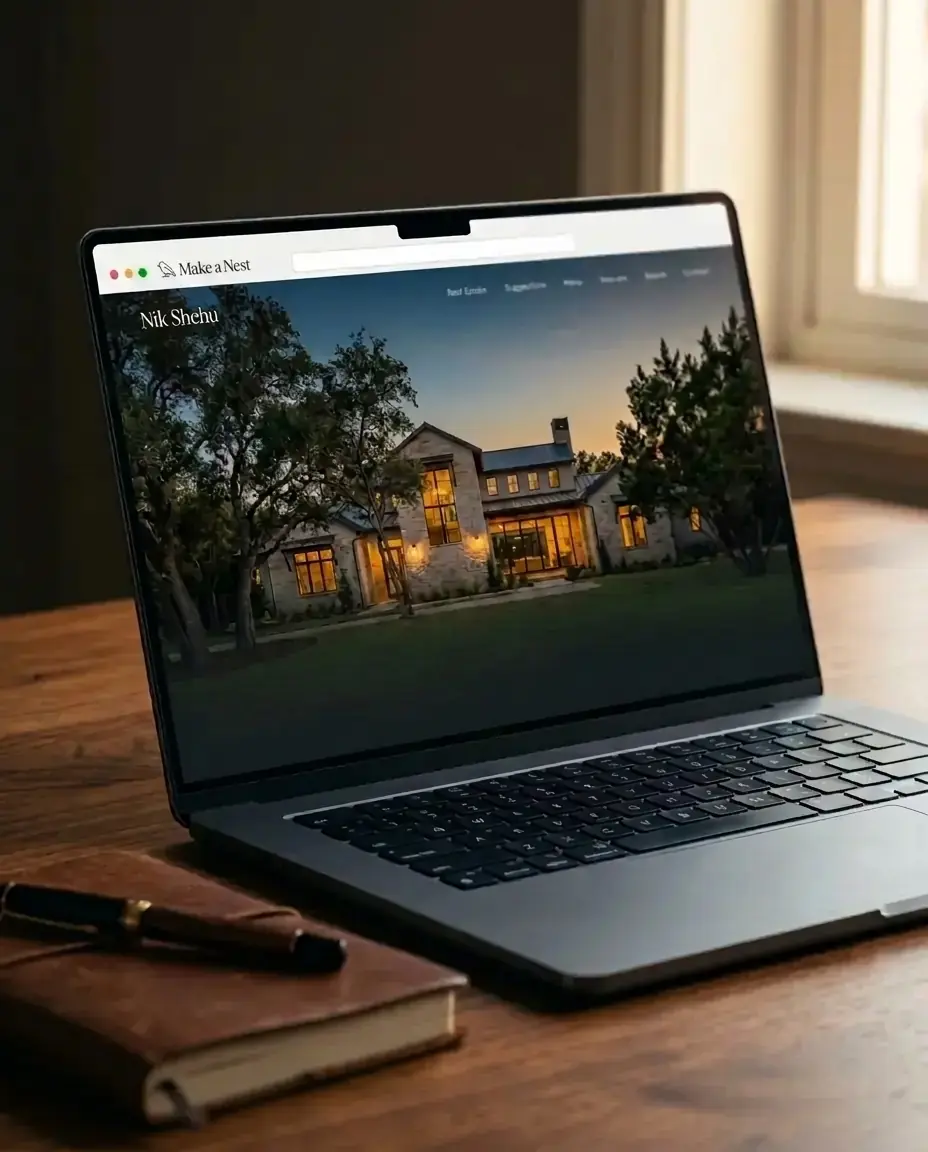
Search your own name today and you'll probably find a Facebook profile, a HAR listing buried among hundreds of other agents, and nothing that says you're the broker now. Make a Nest builds you a real, professional site, your story, your market, your closed deals, live in 72 hours.
"This is way better than the standard agent website. It positions me as a strategic advisor instead of just another Realtor." — Nik Shehu, Broker
What changes when you're a Texas real estate broker.
Every sales agent in Texas works under a sponsoring broker. A real estate broker license removes that requirement and opens up new ways to run your business.
- Work independentlyNo sponsoring broker between you and your commission. You can open your own real estate brokerage under your own name.
- Sponsor your own sales agentsBuild a team. As a sponsoring broker, you earn on your own deals plus a share of the business your agents bring in.
- Serve as a designated brokerA business entity, such as an LLC or corporation, that holds its own broker license must name a designated broker. That can be you.
- Or stay an associate brokerSome brokers keep working under another brokerage by choice. The license is yours either way, and the options stay open.
Every broker renewal also includes TREC's 6-hour Broker Responsibility course as part of your 18 hours of continuing education, whether or not you sponsor agents.
Licensing your business entity as a real estate broker.
Want your brokerage to operate as an LLC, corporation, or partnership? The business entity needs its own Texas broker license, separate from yours. TREC requires the entity to be authorized to transact business in Texas and to designate an active Texas real estate broker to act on its behalf.
- Name a designated brokerAn active individual Texas broker in good standing who is a managing officer of the entity: an officer of a corporation, a manager or managing member of an LLC, or a general partner.
- File through REALMCreate a new application in TREC's REALM Portal and choose the Real Estate Business Broker Application.
- Prove the entity can do business in TexasUpload a Franchise Tax Account Status page issued within 21 days before you apply, plus proof of the designated broker's managing authority.
- Ownership or E&O insuranceIf the designated broker owns at least 10% of the entity, show proof of ownership. If not, the entity must carry errors and omissions insurance of $1 million per occurrence.
Like an individual application, the entity has one year from filing to meet every requirement. See TREC's business entity broker page for the full document list.
Texas real estate broker license questions.
How our students walk in ready.
Twenty years of exam-day phone calls, distilled to four habits. None of them are complicated. All of them work, especially with a 75% bar.

Becoming the broker is easier with one beside you.
Unlimited 1-on-1 tutoring comes standard here, and a real person always picks up. Call and ask anything: your experience points, your hours, how fast you could realistically finish.